Text to Use in Teaching Agtain and Again
Practise'due south and don'ts
Do'due south:
Instructional strategies that can atomic number 82 to change in students' alternative conceptions (misconceptions) and to learning of new concepts and theories:
-
Ask students to write down their pre-existing conceptions of the fabric beingness covered. This allows y'all to overtly assess their preconceptions and provides them with an opportunity to run into how far their understanding has come after learning the new concepts.
-
Consider whether student preconceptions could potentially be beneficial to their learning process. It is possible that preconceived notions nearly material, even if not entirely authentic, could provide a base from which to build noesis of new concepts. For example, using students' correct conceptions and edifice on those past creating a span of examples to the new concept or theory is a benign strategy to help students over misconceptions.
-
Nowadays new concepts or theories that you are instruction in such a manner that students encounter every bit plausible, high-quality, intelligible and generative.
-
Use model-based reasoning, which helps students construct new representations that vary from their intuitive theories.
-
Utilise diverse instruction, wherein yous present a few examples that claiming multiple assumptions, rather than a larger number of examples that challenge only 1 assumption.
-
Help students become enlightened of (heighten student metacognition about) their own alternative conceptions (misconceptions).
-
Present students with experiences that cause cognitive disharmonize in students' minds. Experiences (as in strategy 3 above) that tin can cause cognitive conflict are ones that become students to consider their erroneous (misconception) noesis side-by-side with, or at the same time as, the right concept or theory.
-
Engage in Interactive Conceptual Instruction (ICI).
-
Develop students' epistemological thinking, which incorporates beliefs and theories about the nature of cognition and the nature of learning, in ways that volition facilitate conceptual change. The more naïve students' behavior are about knowledge and learning, the less likely they are to revise their misconceptions.
-
Use case studies equally education tools to farther solidify agreement of new material and reduce student misconceptions.
-
Aid students "self-repair" their misconceptions. If students appoint in a procedure called "self-explanation," then conceptual alter is more likely (Chi, 2000). Self-explanation entails prompting students to explain text aloud as they read.
-
In one case students have overcome their alternative conceptions (misconceptions), appoint them in argument to strengthen their newly caused correct knowledge (representations).
Don'ts:
-
Practice not rely solely on lectures.
-
Do not rely solely on labs or easily-on activities.
-
Practise non rely solely on demonstrations.
-
Do not rely solely on having students just read the text.
-
Exercise not rely solely on a singular perspective when there are multiple means to interpret cloth.
Assess and build on preconceptions
Assessing preconcecptions
When presenting new information to students, it is helpful to first assess any preconceptions they have of the fabric. This allows the instructor to go a more accurate reading on potential misconceptions and offers students an opportunity to see how far they have come in their understanding of newly learned concepts. For example, this tack was taken in a preliminary assessment of student knowledge when teaching students virtually climate change to mensurate:
- Understandings of the distinction between weather and climate.
- Knowledge most the concept of "deep fourth dimension."
- Perceptions of human-induced climatic change at the beginning of the course, and later compared to perception at end of the course.
Run across Lomardi & Sinatra (2012). As well, see Haudek, Kaplan, Knight, et al (2011) on how new engineering involving automated text analysis helps in assessing pupil preconceptions in Stem.
Building on preconceptions
After assessing pupil preconceptions about textile, it is important to consider which components of their already caused knowledge could be beneficial in building a more robust understanding of new concepts. When students come into a course with an initial impression of the curriculum, fifty-fifty if it is inaccurate, it could exist evidence of previous content coverage or a tool for priming student thinking. Though information technology may seem that misconceptions are only a barrier to learning, when used properly they could serve a productive purpose in the classroom (Larkin, 2012).
Present new concepts or theories
In presenting new concepts or theories, teachers should exist sure to show these theories or concepts as:
- Plausible. The new data should be shown to exist consequent with other cognition and able to explain the available data. Learners must come across how the new conception (theory) is consistent with other noesis and a skillful caption of the data
- Loftier quality. Of class, the theory/concept to be taught is of loftier quality from a scientific indicate of view, since it is a correct theory. However, the presented theory should take a better account of the data than what students currently have bachelor to them. For example, the instructor should deal with the trouble from the perspective of the students (e.1000., students for whom a "apartment earth" theory provides a better account of the data available than does a "spherical world" theory). Hence, students must consider the quality of the new theory along with previously learned information.
- Intelligible. Teachers should do what they can to increase the intelligibility of the new theory. Learners must be able to grasp how the new conception works. To increase intelligibility, teachers can use methods such as:
- Analogies (encounter Chiu & Lin, 2005).
- Models (both pictorial conceptual and physical) (See Mayer, 1993; Vosniadou, Ioannides, Dimitrakopoulou, & Papademetriou, 2001 for 5th and 6th graders; Clement, 1993 for high school students; Mayer & Gallini, 1990 for college students).
- Direct exposition (meet Klahr & Nigam, 2004).
- Generative/fruitful. Teachers should evidence that the new concept/theory tin be extended to open up new areas of inquiry. Learners must be able to extend the new conception to new areas of inquiry. Teachers might accomplish this by illustrating the awarding of the new concept/theory to a range of problems. These problems can include familiar ones and new ones.
(Encounter Chinn & Brewer, 1993; Mayer, 2008; Posner, Strike, Hewson, & Gertzog, 1982).
Bridging analogies
One of the best ways that teachers can correct misconceptions is by a strategy called "using bridging analogies." This strategy attempts to span pupils' correct beliefs (called "anchoring conceptions") to the new concept/theory (target) by presenting a series of intermediate similar or analogous examples between the students' initial correct formulation and the new concept or theory (target) to be learned. (see Brown, 1992; Brown & Cloudless, 1989; Clement, 1993; Minstrell, 1982; Yilmaz, Eryilmaz, & Geban, 2006)
Using bridging analogies: continued sequence
Many high school students hold a classic misconception in the area of physics, in particular, mechanics. They erroneously believe that "static objects are rigid barriers that cannot exert forces." The archetype target trouble explains the "at rest" condition of an object. Students are asked whether a table exerts an upward forcefulness on a volume that is placed on the table. Students with this misconception will merits that the table does not push up on a book lying at residue on it. However, gravity and the tabular array exert equal, only oppositely directed forces on the book thus keeping the book in equilibrium and "at remainder." The table's force comes from the microscopic compression or angle of the tabular array. At the same fourth dimension that students hold the misconception almost static objects, they as well believe that a spring pushes up on one's hand when the mitt is pushing downwardly on the leap.
Physicists understand that these two situations — book on table and hand pressing on a spring — are equivalent. The bridging strategy establishes analogical connections between situations that students initially view as not coordinating as a ways to getting students to extend their valid intuitions (the bound) to initially counterintuitive target situations (the table). The use of bridging analogies entails use of concrete examples for a continued sequence, starting from an anchor (situation in which virtually students believe there is upwards force), through an intermediate example(s), to a target situation (volume on table).
- Anchor example: hand on spring.
- Bridging example i: book resting on flexible cream pad.
- Bridging example 2: book resting on lath.
- Target case: book on table.
A similar strategy teachers can try is the utilize of the "bridging representation."
Using bridging analogies: representation
In physics instruction, use of the SRI (symbolic representation of interactions) diagram has been plant to be helpful. SRI emphasizes forces as interactions and makes identification of the mechanical interaction between pairs of objects explicit. Information technology is contrasted with the gratis-body diagram that concentrates on the forces acting on 1 target object. The pedagogic function of the SRI is to provide a bridge, referred to as a "bridging representation."
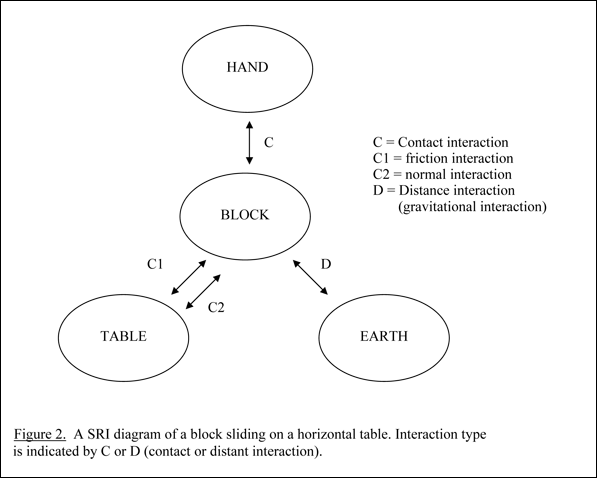
See Savinainen, Scott, & Viiri (2005).
Model-based reasoning
Effective scientific discipline learning often requires that students construct new representations that vary in of import ways from ones used in everyday life. Scientific discipline entails new ways of seeing information in terms of idealized representations or models. Science generally entails mathematical relations, concrete intuitions and sensorimotor activeness schemes in these models. Teachers should teach idealization techniques, such equally thought experiments and limiting instance analyses. These techniques are integral to constructing abstract representations that can facilitate student recognition of deep analogies between superficially different phenomena.
A thought experiment, in the broadest sense, is the use of a hypothetical scenario to help us understand the way things actually are. There are many different kinds of thought experiments. All thought experiments, nevertheless, apply a methodology that is a priori, rather than empirical, in that they do not proceed past observation or concrete experiment. Scientists tend to use thought experiments in the form of imaginary, "proxy" experiments which they conduct prior to a real, "physical" experiment. In these cases, the result of the "proxy" experiment will often be then clear that there will be no need to behave a physical experiment at all. Scientists also utilize thought experiments when item physical experiments are impossible to behave.
Newton'southward cannonball was a thought experiment that Isaac Newton used to hypothesize that the forcefulness of gravity was universal and that information technology was the key strength for planetary movement.
Newton's missive
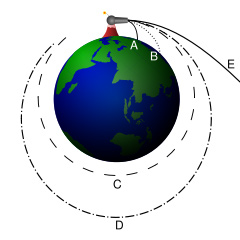
In this experiment Newton visualizes a cannon on top of a very high mount. If at that place was no force of gravitation, the cannonball would follow a directly line away from Globe. And then long as there is a gravitational force acting on the cannon ball, it will follow different paths depending on its initial velocity.
- If the speed is depression, it will simply fall back to World. (A and B)
- If the speed equals some threshold orbital velocity, information technology will go on circling around the World in a fixed round orbit just like the moon. (C)
- If the speed is higher than the orbital velocity, simply not loftier enough to leave Earth birthday (lower than the escape velocity), information technology volition go on rotating around Earth along an elliptical orbit. (D)
- If the speed is very high, it will indeed leave World. (E)
Diverse instruction
Diverse instruction simultaneously challenges at to the lowest degree ii erroneous behavior that underlie a misconception (alternative conception). It is based on a literature that shows adults and children describe stronger inductive inferences from information that impacts various aspects of their underlying behavior (see Hayes, Goodhew, Heit, & Gillan, 2003, for review). Hayes et al. extend the variety principle to conceptual change and propose that shifts in intuitive theories or alternative conceptions (misconceptions) are more likely to occur when people encounter new data that challenges several features or assumptions of these models. Conceptual change is more likely if students are presented with a few examples that challenge multiple assumptions, rather than with a larger number of examples that challenge just one assumption.
In an illustration of diverse instruction, an inquiry-based 5E (engage, explore, explain, extend and evaluate) learning model that incorporates different educational activity styles to engage students with varying learning modalities has been tried with educatee misconceptions (Ray & Beardsley, 2008). Within this model, misconceptions can provide a basis for hypothesis testing that encourage exploration of previously held beliefs and build more than accurate understanding of complicated processes. This further advocates for diversifying pedagogy to uncover educatee strengths and use preconceptions every bit a ground for deeper academic inquiry.
Case: shape of the world
The effect of diverse instructional strategies on children'due south understanding of the shape of the earth has been studied (Hayes et al., 2003). Children'south erroneous beliefs about the globe (their nonbelief in a spherical earth) can be linked to ii more general misconceptions (Vosniadou & Brewer, 1992). One is the belief that the world appears apartment to an observer on the basis. The 2d is a poor agreement of gravity and failure to understand the influence of gravity on objects located on different parts of the world's surface. Indeed, in considering the globe'due south surface, when students think that unsupported objects fall, they are probable to construct either a "disk" model of the earth or a "dual earth" model (with a circular earth located in space co-existing with a flat globe where people live).
In the study, six-year-old children were randomly assigned to ane of iii conditions: control (no training); single-belief training (all iv instructional videos focused on either the relative size of the globe or the effects of gravity); or dual-belief grooming (four instructional videos where ii focused on the relative size of the earth and 2 focused on the effects of gravity). Results showed that only children receiving instruction virtually two core beliefs showed an increased rate of acceptance of a spherical earth model at post-exam time.
Student metacognition
Pupil metacognitive abilities may be critical to achieving conceptual change (Beeth, 1998; Beeth & Hewson, 1999; Case, 1997; Chinn & Brewer, 1993; Gelman & Lucariello, 2002; Inagaki & Hatano, 2002; Minstrell, 1982,1984). Metacognition entails a range of processes, including monitoring, detecting incongruities or anomalies, self-correcting, planning and selecting goals, and reflecting on the structure of 1'due south knowledge and thinking (Gelman & Lucariello, 2002).
Several proficient methods aid students think metacognitively:
-
Engage students in representing their thinking through interactive discussion and open commutation and debate of ideas.
To assist students increment their metaconceptual awareness (sensation of their own cognition), it is important to create learning environments that make it possible for them to express their cognition, including misconception cognition. This tin exist done in environments that facilitate group give-and-take and the verbal expression and debate of ideas. The learning environment should allow for students to limited their knowledge and compare it with those of others. Such activities assist students in becoming aware of what they know and what they need to learn.(Encounter Kuhn, 2006: Minstrell, 1982, 1989; Savinainen & Scott, 2002; Vosniadou et al., 2001)
-
Arm-twist pupil predictions on the topic, followed by a teacher-led sit-in that tests those predictions. Discussion works towards arriving at a mutual observation so reconciles differences betwixt prediction and observation.
Keep in mind that students (or anyone) can be biased past the ideas (in this case, misconceptions) they already accept when observing things. As such, this tin really interfere with observing events correctly. Chinn & Malhotra (2002) have noticed "theory bias at the observation stage." For example, only nigh 26 per centum of children correctly predicted that a heavy and light rock would striking the ground at the same time (cited in Mayer 2008). An of import point is to make the data (to be observed) then obvious that information technology minimizes incorrect observations by students (Mayer, 2008).
(Meet Kuhn, 2006; Champagne, Gunstone, & Klopfer, 1985; Gunstone, Robin Gray, & Searle, 1992: Use of Predict-Detect-Explain (P-O-Eastward); Mayer, 2008; Minstrell, 1982)
-
Provide opportunities for reflective inquiry and cess (White & Frederickson, 1998).
White and colleagues designed a estimator-based micro-world "Thinker Tools" (TT)(1993; White & Frederiksen, 1998). This is a middle school science curriculum that engages students in learning about and reflecting on the processes of science inquiry as they construct increasingly complex models of force and motion phenomena. The TT inquiry curriculum centers around a metacognitive model of research, called the inquiry cycle, and a metacognitive process, called reflective assessment, in which students reflect on their own and each other's inquiry strategies.
Predict-notice-explain teaching strategy
In the "predict-observe-explain" (P-O-E) strategy, the teacher plans/presents a demonstration or example that southward/he volition subsequently conduct/explicate. The topic or issue of the demonstration or example should be one that relates to possible student misconceptions and the blueprint of the demonstration/case should exist to arm-twist such misconceptions. Before conducting the sit-in, pupils predict what volition occur. The teacher then conducts the sit-in (explicates the illustration/instance) and the students notice this. After the sit-in (illustrative case), the students must explicate why their observations conflicted with their predictions.
The P-O-E strategy does not entail the traditional hands-on laboratory piece of work washed past students themselves. When the teacher does the sit-in, information technology allows students to focus more of their intellectual resource on the conceptual issues at paw, including making predictions.
Inquiry cycle
The inquiry cycle guides students' research and helps them sympathize what the research procedure is all virtually.
- It begins with formulating an investigable question.
- It moves to a predict phase, wherein students generate culling hypotheses and predictions with respect to the question.
- Adjacent comes the experiment stage, wherein students design and carry-out experiments in the real world and on the calculator.
- Students and so motion to the model phase, wherein they clarify their data to construct a conceptual model that includes scientific laws that would predict and explain their findings.
- Finally, comes the apply phase, wherein students utilize their model to different situations to investigate the model's utility and limitations. This raises new questions in the procedure and the cycle begins again.
Students become through the research cycle for each research topic in the curriculum. They engage in reflective assessment at each step in the inquiry cycle and later on each completion of the cycle.
The reflective assessment component provides students with "criteria for judging research":
- Goal-oriented criteria, such every bit "understanding the scientific discipline."
- Process-oriented criteria, such as "being systematic" and "reasoning carefully."
- Socially-oriented criteria, such every bit "communicating well."
3 teachers in 12 urban classes (across grades 7 to 9) implemented the TT curriculum. The sample included many low-achieving and disadvantaged students. Findings show that the reflective assessment component greatly facilitated student learning.
Cognitive disharmonize
The idea that cognitive conflict or disequilibrium can lead to learning is rooted in Piagetian theory. Piaget proposed that cerebral conflict or "disequilibrium" arises when students encounter experiences that they are non able to assimilate or that are incongruous with their current cognitive structures/conceptions. Cognitive disharmonize can pb to conceptual change or adaptation of current cognitive concepts.
In that location are a variety of means that teachers generate cognitive conflict in the mind of the pupil:
-
Present students with anomalous data (data that do non accord with their misconception).
This strategy is idea to exist a major means of eliciting cognitive conflict and getting students to change or abandon their electric current erroneous theories and adopt new ones. Still, but presenting anomalous data is not sufficient. Students have been plant to ignore or refuse such data, profess uncertainty about their validity, and reinterpret the information, amidst other things (Chinn & Brewer, 1998). There are certain optimal ways to represent such data. -
Nowadays students with refutational texts (texts wherein a misconception is explicitly refuted by presenting contrasting information).
Present refutational texts alone or in combination with discussion, conducted under teacher guidance. The discussion, which can occur between peers, should require students to articulate and back up their views with evidence from the text.A refutational text introduces a common misconception, refutes it, and offers a new (culling) theory that proves to exist more than satisfactory. In this manner, refutational texts are a means to create cognitive conflict. The post-obit text from Hynd (2001) is an instance of refutational text:
"Despite the fact that many people remember that a rolling ball volition slow or stop on its own, this will not happen... Moving objects will proceed moving at a constant rate unless they are slowed or stopped, or their direction is changed because of an outside strength such as friction." (Encounter Diakidoy, Kendeou, & Ioannides, 2003; Guzzetti, Snyder, Glass, & Gamas, 1993; Guzzetti, 2000; Hynd, 2001; Maria & MacGinitie, 1987).
-
Present students with text that presents the new theory or concept.
At the same time use teacher strategies or activities that elicit the students' misconceptions such that they consider the conflict between the ii. -
Acquit conceptual change discussions.
Best ways to present anomalous information
Of class, students might not accept the anomalous or contradictory data and therefore not modify their minds. Teachers can increase the chances of dissonant information being accustomed and leading to conceptual modify by:
-
Making the anomalous data credible. This tin can exist washed in a few ways. Teachers tin can make it clear that the data were collected according to accepted principles. In addition, alive demonstrations and hands-on experiences may also increment the brownie of the dissonant data. Also teachers tin entreatment to existent-world data that students already know about (as in the use of anchoring conceptions as described earlier in the bridging analogies strategy discussion)
-
Fugitive ambiguous data. Cull information that are perceptually obvious. Likewise, if teachers are aware of the specific misconceptions their students take, they can choose data, in light of that, that will be unambiguous to their students
-
Presenting multiple lines of data when necessary. In presenting anomalous data, single experiments are oft not convincing. Hence, introducing multiple lines of data, such equally use of a series of experiments, should be helpful. If using a single experiment/sit-in, it is useful to be prepared to address student objections effectively
-
Introducing the anomalous data early in the instructional process. This might be helpful because it appears that the more groundwork noesis in the topic students possess the more their misconceptions impede the acceptance of anomalous data
-
Engaging students in justification of their reasoning virtually the dissonant information.(See Chinn & Brewer 1993 and Posner et al., 1982)
Activities to produce cerebral conflict
Some activities that produce cognitive conflict when used in combination with text are:
- Augmented activation activities. This activeness has 2 components. 1 is the activation activity designed to activate or bring to students' attention their misconception cognition (e.thousand., by request them to call up or reiterate their belief; by reminding them of their belief). The second is directing the reader'due south attention to contradictory information in the text or providing illustrative demonstrations that are incongruous with the misconception. This instructional strategy is similar to the Socratic teaching method and involves students in dialogues that compel them to handle counterexamples and confront contradictions to their misconceptions.
- The Discussion Web. This is a discussion strategy led by teacher. It can entail using a graphic aid to grade students' positions around a central question. Students are required to take a stance (due east.g., on the shape of the earth), defend their positions, and persuade each other with evidence from the text. Direct questioning helps students rethink their prior conceptions.
- Recollect sheets. This is a written contrast of pupil-generated and text-generated ideas of a concept posed equally a central question. It is a text-based activeness that contrasts learners' preconceptions to scientific conceptions from text. Learners then self-monitor their prior knowledge in lite of information from the text and from the give-and-take.
(Come across Guzzetti, 2000; Guzzetti et al., 1993; Hynd, 2001.)
Protocol for conceptual change give-and-take
From Eryilmaz (2002)
The conceptual assignments were chosen equally topics for the discussions for all groups. Discussions were held according to the following guidelines that were provided to the teachers:
- Use the conceptual question every bit an exposing event that helps students expose their conceptions near a specific concept or dominion.
- Permit all students to make their ain conceptions or hypotheses explicit (verbally and pictorially).
- Ask what students believe or think about the phenomena and why they think so.
- Write or draw students on the blackboard even if they are not correct.
- Be neutral doing the discussion. If i or some students give the right reply, take information technology as another suggestion and play the devil's advocate.
- Be patient. Give enough time to the students to think and respond to the questions.
- Ask simply descriptive questions in this office to sympathise what students actually call up about the phenomena.
- Attempt to get more than students involved in the give-and-take by asking questions of each student.
- Assistance students in stating their ideas conspicuously and concisely, thereby making them aware of the elements in their own preconceptions.
- Encourage confrontation in which students contend the pros and cons of their dissimilar preconceptions and increase their awareness and understanding of the differences between their own preconceptions and those of their classmates.
- Encourage interaction amidst students.
- Create a discrepant event, one that creates conflict betwixt exposed preconceptions and some observed miracle that students cannot explain.
- Let students become aware of this conflict: cerebral dissonance, conceptual conflict, or disequilibrium.
- Help students to adapt the new ideas presented to them. The instructor does not bring students the message, but she or he makes them enlightened of their state of affairs through dialogue.
- Brand a brief summary from beginning to the end of discussion.
- Prove explicitly where oversimplification, exemplification, clan, and multiple representations have happened, if whatsoever. If non, give exemplification, associations with other topics, and multiple representations for the topic.
- Give students a feeling of progress and growth in mental power, and help them develop confidence in themselves and their abilities.
Interactive conceptual pedagogy (ICI)
Interactive conceptual instruction (ICI), described and studied past Savinainen & Scott (2002), incorporates several central pedagogical aspects:
- Apply of interactive approaches that entail ongoing teacher-student dialogue, which focuses on developing conceptual understandings and wherein students have the opportunity to talk through their understandings with the back up of the teacher.
- Teacher use of inquiry-based instruments (questionnaires/assessments/ inventories) that beget quick and detailed formative assessments of students' knowledge in a subject-area.
- Teachers' development of a detailed map of the conceptual terrain of the field of study area, including cognition of the canonical information in the subject, student misconceptions and the representations (understandings) between these two.
Develop student thinking about knowledge and learning
Conceptual change is facilitated if students view noesis as:
- Complex (not simple).
- Uncertain and evolving (not stable and absolute).
Conceptual change is facilitated if students view learning as:
- A gradual, tedious process (not as "quick or not at all").
- An ability that is improvable (malleable) (not stock-still or unmodifiable).
Conceptual change is likewise facilitated by addressing students' epistemologies about specific domains.
For case, with respect to scientific discipline, having students reflect on the nature of scientific discipline (see Smith, Maclin, Houghton, & Hennessey, 2000) and on the criteria that characterize good inquiry facilitate conceptual alter in science.
(See Mason, 2002, for review.)
Engage argument to strengthen newly acquired right cognition
Engaging in argument may be a key way that a educatee'due south new conceptual system becomes strengthened and overtakes a student's alternative conceptions (misconceptions). Argument entails asking students to evaluate or debate the capability of a new system with competing culling conceptions (misconceptions). Students, even in the elementary school years, are sensitive to many of the features that make for a proficient concept/theory, such every bit plausibility, fruitfulness and explanatory coherence.
Children really seem to prefer accounts that explain more, are non ad hoc, are internally consistent, and fit the empirical data (Samarapungavan, 1992).
(Meet Committee on Science Learning, Kindergarten through Eighth Grade, 2007. See also Duschl & Osborne, 2002, for how to support and promote argumentation type discourse.)
Employ case studies
The issue of using instance studies in didactics chemistry on pupil agreement of the material and their level of misconceptions after existence exposed to the new content has been studied (Ayyldz & Tarhan, 2013). Students who received instruction that included case studies rather than a traditional lecture format demonstrated college knowledge and fewer misconceptions through accomplishment test scores. These instance studies were "real world" scenarios with accompanying references that required explanation through properties learned in the chemical science classroom.
For instance, students may exist asked to explain how information technology is possible for a fly to walk on water but information technology is not possible for a man to practise the aforementioned. Rather than simply asking most comparing the density of liquids and solids, this offered students the opportunity to use the concepts and build a more robust grasp of the material. This suggests that education students new cloth through the use of case studies can lead to greater understanding of the material and prevent time to come misconceptions.
Why and how practice these teaching strategies work?
Students do not come to schoolhouse as bare slates to be filled past instruction. Children are agile cerebral agents who get in at schoolhouse after years of cerebral growth (Commission on Science Learning, Kindergarten through Eighth Form, 2007). They come to the classroom with considerable knowledge based on intuitions, every twenty-four hours experiences, or what they have been taught in other contexts. This pre-instructional cognition is referred to as preconceptions. Since a considerable amount of our knowledge is organized past subject areas, such equally mathematics, science, etc., so as well are preconceptions.
It is important for teachers to know about the preconceptions of their students considering learning depends on and is related to pupil prior knowledge (Bransford, Brownish, & Cocking, 2000; Gelman & Lucariello, 2002; Piaget & Inhelder, 1969; Resnick, 1983). We interpret incoming information in terms of our current knowledge and cognitive organizations. Learners try to link new information to what they already know (Resnick, 1983). This kind of learning is known as assimilation (Piaget & Inhelder, 1969). When new information is inconsistent with what learners already know it cannot be assimilated. Rather, the learner's knowledge volition take to change or be altered because of this new information and experience. This kind of learning is known as accommodation (of knowledge/mental structures).
Whether learning is a matter of assimilation or accommodation depends on whether student preconceptions are anchoring conceptions or culling conceptions (misconceptions), respectively. Pupil preconceptions that are consistent with concepts in the assigned curriculum are anchoring conceptions. Learning, in such cases, is a affair of assimilation or conceptual growth. It consists in enriching or calculation to student cognition. Absorption is an easier kind of learning considering prior cognition does not interfere with learning. Rather, prior noesis is a base the learner can rely on to build new noesis.
Culture tin have a considerable bear upon on students' preconceptions about material, as the earth in which they live provides a meaning-making lens for what they learn in schoolhouse. Some students may find that they are able to balance new information and experiences with those that they have already incorporated into their life by being "cultural straddlers" (Carter, 2006). For other students who have more difficulty achieving this balance, it may be that more directed piece of work is necessary to help them understand concepts that are more than foreign to them at the time of their teaching.
Pupil preconceptions that are inconsistent with, and even contradict, concepts in the curriculum, are alternative conceptions or misconceptions (or intuitive theories). Intuitive theories are very typical and children and adults possess them. They develop from the natural effort to make sense of the world around united states of america. For case, the "distance theory" (a misconception) that explains seasonal/temperature change in terms of different distances between the Earth and the Sun in summer and winter could easily develop from one'southward everyday experience with heat sources (Kikas, 2004). Sometimes even textbooks themselves can be the crusade of alternative theories. For instance, a diagram of the world'due south orbit commonly used in textbooks presents a stretched-out ellipse (although it more than closely resembles a circle) that can contribute to the erroneous "distance theory" of seasonal change (Kikas, 1998). Hence, intuitive theories or misconceptions are not a reflection of a cognitively deficient kid. Rather, they reverberate a child with a cognitively agile listen, who has already achieved considerable complex and abstruse knowledge. Indeed, young children are not limited to physical reasoning. Nor should they exist viewed as a bundle of misconceptions.
Alternative conceptions (misconceptions) interfere with learning for several reasons. Students use these erroneous understandings to interpret new experiences, thereby interfering with correctly grasping the new experiences. Moreover, misconceptions can exist entrenched and tend to be very resistant to pedagogy (Brewer & Chinn, 1991; McNeil & Alibali, 2005). Hence, for concepts or theories in the curriculum where students typically take misconceptions, learning is more challenging. It is a matter of adaptation. Instead of simply adding to student noesis, learning is a matter of radically reorganizing or replacing educatee knowledge. Conceptual change or adaptation has to occur for learning to happen (Carey, 1985; 1986; Posner et al., 1982; Strike & Posner, 1985, 1992). Teachers will need to bring nearly this conceptual modify.
According to conceptual modify theory, learning involves three steps (see Mayer, 2008 for summary):
- Recognizing or detecting an anomaly. This refers to condign aware that your current mental model (representation or theory or conception) is inadequate to explicate observable facts. The student must realize that he/she has a misconception(southward) that must be discarded or replaced
- Constructing a new model. This entails finding a ameliorate, more sufficient model that is able to explicate the observable facts. Information technology involves the students' replacing i model with another
- Using a new model. This refers to students using the new model to find a solution when presented with a problem. This reflects an ability to solve problems with the new model.
Hence mental models (representations of theories or concepts) are at the core of conceptual-alter theory. For example, you are using a mental model when you call up of the earth as hollow.
Traditional methods of didactics used in isolation, such as lectures, labs, discovery learning or but reading text have not been institute to be effective at achieving conceptual alter (Chinn & Brewer, 1993; Kikas, 1998; Lee, Eichinger, Anderson, Berkheimer, & Blakeslee, 1993; Roth, 1990; Smith, Maclin, Grosslight, & Davis, 1997). Recommended alternative instruction strategies are included in this module.
FAQs
Is it normal for students to have misconceptions? Do most students accept them?
Yes, it is very typical for students to have misconceptions. They are caused or formed through everyday experiences, through pedagogy on other topics, and because some concepts are very complex to main.
Are in that location typical common misconceptions that students have in unlike academic subjects?
Yes, at that place are typical misconceptions that students have in the different subjects, such equally math and science. Existence aware of the typical misconceptions students have in these subject areas can assistance y'all focus your instruction to address the most mutual misconceptions.
Are these strategies to correct pupil misconceptions applicable to all children?
These strategies are general enough to exist effective with most children. Still, various strategies are optimally appropriate and constructive at specific grade levels. Moreover, a teacher should use his or her judgment about which strategies might be most constructive, given the particular students in the class. For example, for students that take language difficulties (east.thou., difficulty reading and processing text and articulating thoughts verbally) the teacher might rely more on the less-verbal strategies (e.g., utilize of bridging analogies) with those students.
When do do these recommendations work?
Age
Almost all these recommendations can be used with students from the elementary grades (beginning at around 5th Form) through high school. In the case of using bridging analogies (recommendation #ii), this strategy is most suitable for high school students.
Individual differences
Nosotros know very footling most how these recommendations might vary by gender or ethnicity. There is proficient reason to believe, still, that most, if not all, of these recommendations would be generally successful with most students. The little research that has been conducted with different sub-groups of children and youth suggests that these strategies would be comparably effective with low-achieving children (as well as with better performing children).
Contextual factors
We know very little most how these recommendations might vary by contextual factors, such every bit for children living in poverty and unlike kinds of family constellations. Nosotros do know that misconceptions are quite universal. There is expert reason to believe, however that most, if not all, of these recommendations for getting students over their misconceptions would be generally successful with most students. The little research that has been done with 7th through 9th course urban classes that had many disadvantaged students suggests that these strategies would be effective for low-SES children. In that location is no reason to believe that family variables would play any role in the effectiveness of these strategies.
Where can teachers go more information?
Bransford, J. D., Chocolate-brown, A. L., & Cocking, R. R. (Eds.). (2000). How people learn: Encephalon, mind, feel, and schoolhouse. Washington, DC: National Academies Printing.
Brown, J. S., & Burton, R. R. (1978). Diagnostic models for procedural bugs in bones mathematical skills. Cognitive Science, ii, 155-192.
Commission on Science Learning, Kindergarten through Eighth Grade. (2007). Taking scientific discipline to school: Learning and pedagogy science in grades K-8. Washington, DC: National Academies Printing.
Duschl, R., & Osborne, J. (2002). Supporting and promoting argumentation discourse. Studies in Scientific discipline Didactics, 38, 39-72.
Eryilmaz, A. (2002). Effects of conceptual assignments and conceptual change discussions on students' misconceptions and achievement regarding forcefulness and motion. Journal of Research in Science Teaching, 39, 1001-1015.
Guzzetti, B. J., Snyder, T. E., Drinking glass, G. 5., & Gamas, W. S. (1993). Promoting conceptual change in science: A comparative meta-assay of instructional interventions from reading education and science education. Reading Research Quarterly, 28, 116-159.
Haudek, Kevin C., Kaplan, Jennifer J., Knight, Jennifer, Long, Tammy, Merrill, John, Munn, Alan, ... Urban-Lurain, Marker. (2011). Harnessing Technology to Better Formative Assessment of Student Conceptions in Stem: Forging a National Network. CBE - Life Sciences Didactics, (2), 149-155.
Hayes, B. K., Goodhew, A., Heit, E., & Gillan, J. (2003). The role of various instruction in conceptual alter. Journal of Experimental Child Psychology, 86, 253-276.
Hynd, C. R. (2001). Refutational texts and the change process. International Journal of Educational Research, 35, 699-714.
Mayer, R. E. (2003). Learning and education. Upper Saddle River, NJ: Pearson Teaching, Inc.
Mayer, R. Eastward. (2008). Learning and didactics (second ed.). Upper Saddle River, NJ: Pearson Teaching, Inc.
Minstrell, J. (1982). Explaining the "at remainder" condition of an object. The Physics Instructor, 20, 10-14.
Posner, Yard. J., Strike, K. A., Hewson, P. W., & Gertzog, Due west. A. (1982). Accommodation of a scientifc conception: Toward a theory of conceptual alter. Scientific discipline Instruction, 66, 211-227.
Resnick, L. B. (1983). Mathematics and scientific discipline learning: A new conception. Scientific discipline, 220, 477-478.
Siegler, R. S. (2003). Implications of cognitive science research for mathematics didactics. In J. Kilpatrick, Due west. B. Martin, & D. E. Schifter (Eds.), A inquiry companion to principles and standards for school mathematics (pp. 219-233). Reston, VA: National Council of Teachers of Mathematics.
References
Alexander, P. A. (2006). Psychology in learning and instruction. Upper Saddle River, NJ: Pearson Education, Inc.
Arnaudin, M., & Mintzes, J. (1985). Students' alternative conceptions of the human circulatory system: A cantankerous-historic period study. Science Education, 69(5), 721-733.
Arnaudin, M., & Mintzes, J. (1986). The cardiovascular organization: Children's conceptions and misconceptions. Science and Children, 23(5), 48-51.
Atwood, R. One thousand., & Atwood, 5. A. (1996). Preservice elementary teachers' conceptions of the causes of seasons. Periodical of Research in Science Pedagogy, 33(5), 553-563.
Ayyldz, Y., & Tarhan, L. (2013). Case study applications in chemistry lesson: Gases, liquids, and solids. Chemical science Education Enquiry and Practice, fourteen(iv), 408-420.
Baxter, J. (1995). Children's agreement of astronomy and Earth sciences. In Southward. M. Glynn & R. Duit (Eds.), Learning science in the schools (pp. 155-178). Mahwah, NJ: Erlbaum.
Beeth, K. Due east. (1998). Teaching science in 5th form: Instructional goals that back up conceptual modify. Journal of Inquiry in Science Didactics, 35(10), 1091-1101.
Beeth, One thousand. Due east., & Hewson, P. W. (1999). Learning goals in an exemplary science teacher's practice: Cognitive and social factors in education for conceptual change. Science Instruction, 83(6), 738-760.
Bransford, J. D., Brown, A. Fifty., & Cocking, R. R. (Eds.). (2000). How people larn: Brain, mind, experience, and schoolhouse. Washington, DC: National Academy Press.
Brewer, W. F., & Chinn, C. A. (1991). Entrenched beliefs, inconsistent information, and knowledge alter. In Fifty. Birnbaum (Ed.), The International Conference of the Learning Sciences: Proceedings of the 1991 conference (pp. 67-73). Charlottesville, VA: Association for the Advancement of Calculating in Education.
Brown, D. E. (1992). Using examples and analogies to remediate misconceptions in physics: Factors infuencing conceptual modify. Periodical of Research in Science Educational activity, 29(1), 17-34.
Brown, D. E., & Clement, J. (1989). Overcoming misconceptions via analogical reasoning: Abstruse transfer versus explanatory model construction. International Science, eighteen, 237-261.
Brown, J. S., & Burton, R.R. (1978). Diagnostic models for procedural bugs in basic mathematical skills. Cerebral Science, 2, 155-192.
Burgoon, Jacob Due north., Heddle, Mandy L., & Duran, Emilio. (2010). Re-Examining the Similarities between Teacher and Educatee Conceptions nigh Concrete Science. Journal of Scientific discipline Instructor Education, (seven), 859-872.
Carey, S. (1985). Conceptual change in childhood. Cambridge, MA: MIT Press.
Carey, Due south. (1986). Cognitive scientific discipline and science education. American Psychologist, 41, 1123-1130.
Carter, Prudence Fifty. (2006). Straddling Boundaries: Identity, Culture, and School. Sociology of Didactics, 79(four), Vol.79(4), p.304.
Case, R. (1997). The development of conceptual structures. In D. Kuhn & R. S. Siegler (Eds.), Handbook of child psychology (Vol ii): Perception, cognition, and language (pp. 745-800). New York: Wiley.
Champagne, A. B., Gunstone, R. F., & Klopfer, L. E. (1985). Effecting changes in cognitive structures among physics students. In H. T. Due west & A. L. Pines (Eds.), Cerebral structure and conceptual alter (pp. 61-90). Orlando, FL: Academic Printing.
Chi, Thousand. T. H. (1992). Conceptual change within and across ontological categories: Implications for learning and discovery in science. In R. Giere (Ed.), Minnesota studies in the philosophy of science (Vol XV): Cerebral models of scientific discipline (pp. 129-186). Minneapolis, MN: University of Minnesota Press.
Chi, M. T. H. (2000). Self-explaining: The dual processes of generating inference and repairing mental models. In R. Glaser (Ed.), Advances in instructional psychology (Vol 5): Educational blueprint and cognitive science (pp. 161-238). Mahwah, NJ: Erlbaum.
Chi, M. T. H. (2005). Commonsense conceptions of emergent processes: Why some misconceptions are robust. The Periodical of the Learning Sciences, xiv, 161- 199.
Chinn, C. A., & Brewer, W. F. (1993). The role of anomalous data in knowledge acquisition: A theoretical framework and implications for science teaching. Review of Educational Research, 63, 1-49.
Chinn, C. A., & Brewer, W. F. (1998). An empirical examination of a taxonomy of responses to anomalous information in science. Journal of Research in Science Teaching, 35(vi), 623-654.
Chinn, C. A., & Malhotra, B. A. (2002). Children's responses to anomalous scientific data: How is conceptual change impeded? Journal of Educational Psychology, 94(two), 327-343.
Chiu, Thousand. H., & Lin, J. Due west. (2005). Promoting fourth graders' conceptual change of their agreement of electric electric current via multiple analogies. Journal of Research in Scientific discipline Teaching, 42(iv), 429-464.
Cloudless, J. (1982). Students' preconceptions in introductory mechanics. American Journal of Physics, 50(one), 66-71.
Committee on Science Learning, Kindergarten through Eighth Class (2007). Taking scientific discipline to school: Learning and teaching science in grades K-8. Washington, DC: National Academies Press.
Diakidoy, I. A., Kendeou, P., & Ioannides, C. (2003). Reading about energy: The effects of text structure in scientific discipline learning and conceptual change. Contemporary Educational Psychology, 28(3), 335-356.
Duschl, R., & Osborne, J. (2002). Supporting and promoting argumentation discourse. Studies in Science Education, 38, 39-72.
Eryilmaz, A. (2002). Effects of conceptual assignments and conceptual change discussions on students' misconceptions and achievement regarding force and motility. Periodical of Research in Science Teaching, 39(10), 1001-1015.
Falkner, Thousand. P., Levi, 50., & Carpenter, T. P. (1999). Children'southward agreement of equality: A foundation for algebra. Teaching Children Mathematics, six(4), 232-236.
Fischbein, Eastward., Deri, M., Nello, M., & Marino, M. (1985). The function of implicit models in solving verbal bug in multiplication and partition. Journal for Research in Mathematics Instruction,sixteen, 3-17.
Gelman, R., & Lucariello, J. (2002). Part of learning in cognitive development. In H. Pashler (Series Ed.) & C. R. Gallistel (Vol. Ed.), Stevens' handbook of experimental psychology: Vol. iii. Learning, motivation, and emotion (3rd ed., pp. 395- 443). New York: Wiley.
Goulding, Yard., Rowland, T., & Hairdresser, P. (2002). Does it thing? Primary instructor trainees' subject knowledge in mathematics. British Educational Research Journal, 28(5), 689-704.
Gunstone, R. F., Robin Grey, C. M., & Searle, P. (1992). Some long-term effects of uninformed conceptual change. Science Educational activity, 76(2), 175-197.
Guzzetti, B. J. (2000). Learning counter-intuitive science concepts: What have we learned from over a decade of research? Reading & Writing Quarterly, 16(2), 89-98.
Guzzetti, B. J., Snyder, T. E., Glass, Yard. V., & Gamas, Westward. S. (1993). Promoting conceptual change in scientific discipline: A comparative meta-analysis of instructional interventions from reading instruction and science teaching. Reading Research Quarterly, 28, 116-159.
Hartnett, P., & Gelman, R. (1998). Early on understandings of numbers: Paths or barriers to the construction of new understandings? Learning and Education, 8(four), 341-374.
Hatano, G., Siegler, R. Southward., Richards, D. D., Inagaki, K., Stavy, R., & Wax, Due north. (1997). The development of biological noesis: A multi-national study. Cerebral Development, 8, 47-62.
Hayes, B. Thou., Goodhew, A., Heit, Due east., & Gillan, J. (2003). The part of diverse instruction in conceptual change. Journal of Experimental Kid Psychology, 86, 253-276.
Hynd, C. R. (2001). Refutational texts and the modify process. International Journal of Educational Inquiry, 35(seven), 699-714.
Inagaki, K., & Hatano, G. (2002). Young children's naïve thinking most the biological world. New York: Psychology Press.
Keil, F. C. (1979). Semantic and conceptual evolution: An ontological perspective. Cambridge, MA: Harvard University Printing.
Kieran, C. (1981). Concepts associated with the equality symbol. Educational Studies in Mathematics, 12, 317-326.
Kieran, C. (1992). The learning and educational activity of school algebra. In D. A. Grouws (Ed.), Handbook of enquiry on mathematics didactics and learning (pp. 390- 419). New York: Macmillan.
Kikas, Due east. (1998). The impact of teaching on students' definitions and explanations of astronomical phenomena. Learning and Instruction, viii(5), 439-454.
Kikas, Due east. (2003). Academy students' conceptions of different physical phenomena. Journal of Developed Development, 10(3), 139-150.
Kikas, East. (2004). Teachers' conceptions and misconceptions concerning three natural phenomena. Journal of Inquiry in Scientific discipline Teaching, 41, 432-448.
Klahr, D. & Nigam, K. (2004). The equivalence of learning paths in early science educational activity: Effects of direct instruction and discovery learning. Psychological Scientific discipline, 15, 661-667.
Knuth, E. J., Alibali, 1000. West., McNeil, North. M., Weinberg, A., & Stephens, A. C. (2005). Middle school students' understanding of core algebraic concepts: Equivalence and variable. International Journal of Mathematics Education, 37, 1-nine.
Kuchemann. (1978). Children's understanding of numerical variables. Mathematics in Schoolhouse, 7(4), 23-26.
Kuhn, D. (2006). Practice children and adults acquire differently? Journal of Knowledge and Evolution, vii, 279-293.
Larkin, Douglas. (2012). Misconceptions about "Misconceptions": Preservice Secondary Science Teachers' Views on the Value and Role of Student Ideas. Science Didactics, (5), 927-959.
Lee, O., Eichinger, D. C., Anderson, C. W., Berkheimer, Grand. D., & Blakeslee, T. D. (1993). Irresolute center schoolhouse students' conceptions of affair and molecules. Journal of Research in Science Teaching, 30(iii), 249-270.
Lombardi, Doug, & Sinatra, Gale M. (2012). Higher Students' Perceptions nearly the Plausibility of Human-Induced Climate change. Research in Scientific discipline Education, (ii), 201-217.
MacGregor, G., & Stacey, K. (1997). Students' understanding of algebraic notation: 11-fifteen. Educational Studies in Mathematics, 33, 1-xix.
Maria, K., & MacGinitie, W. (1987). Learning from texts that refute the reader's prior noesis. Reading Research and Teaching, 26, 222-238.
Mason, L. (2002). Developing epistemological thinking to foster conceptual change in different domains. In M. Limon & 50. Stonemason (Eds.), Reconsidering conceptual change: Issues in theory and exercise (pp. 301-335). Netherlands: Kluwer Bookish Publishers.
Stonemason, K., & Ruddock, K. (1986). Decimals. Windsor, Ontario, Canada: APU/NFER-Nelson.
Mayer, R. E. (1993). Illustrations that instruct. In R. Glaser (Ed.), Advances in instructional psychology (Vol. 4, pp. 253-284). Hillsdale, NJ: Erlbaum.
Mayer, R. East. (2008). Learning and instruction (2nd ed.) . Upper Saddle River, NJ: Pearson Education, Inc.
Mayer, R. E., & Gallini, J. G. (1990). When is an illustration worth x thousand words? Journal of Educational Psychology, 82(four), 715-726.
McCloskey, One thousand. (1983). Intuitive physics. Scientific American, 248(4), 122-130.
McCloskey, 1000., Caramazza, A., & Green, B. (1980). Curvilinear motion in the absenteeism of external forces: Naïve behavior well-nigh the motion of objects. Science, 210, 1139-1141.
McNeil, Northward. M., & Alibali, M. W. (2005). Why won't y'all change your mind? Noesis of operational patterns hinders learning and performance on equations. Child Development, 76, 883-899.
Minstrell, J. (1982). Explaining the "at rest" condition of an object. The Physics Teacher, 20, ten-14.
Minstrell, J. (1984). Pedagogy for the evolution of understanding of ideas: Forces on moving objects. In C. West. Anderson (Ed.), Observing classrooms: Perspectives from research and practice (pp. 67-85). Columbus, OH: Ohio Land Academy.
Minstrell, J. (1989). Pedagogy science for agreement. In L. B. Resnick & 50. E. Klopfer (Eds.), Toward the thinking curriculum: Electric current cognitive research (pp. 129-149). Alexendria, VA: Association for Supervision and Curriculum Evolution.
Nunes, T., & Bryant, P. (Eds.). (1996). Children doing mathematics. Oxford: Blackwell.
Ojala, J. (1997). Lost in infinite? The concepts of planetary phenomena held past trainee principal school teachers. International Enquiry in Geographical and Environmental Pedagogy, half dozen, 183-203.
Pelaez, N. J., Boyd, D. D., Rojas, J. B., & Hoover, Yard. A. (2005). Prevalence of blood circulation misconceptions among prospective elementary teachers. Advances in Physiology Didactics, 29, 172-181.
Piaget, J., & Inhelder, B. (1969). The psychology of the child. New York: Basic Books,.
Posner, G. J., Strike, Yard. A., Hewson, P. Westward., & Gertzog, W. A. (1982). Accommodation of a scientifc conception: Toward a theory of conceptual change. Scientific discipline Education, 66(two), 211-227.
Ray, A., & Beardsley, P. (2008). Overcoming Educatee Misconceptions about Photosynthesis: A Model- and Enquiry-Based Approach Using Aquatic Plants. Science Activities: Classroom Projects and Curriculum Ideas, 45(1), 13-22.
Resnick, L. B. (1983). Mathematics and science learning: A new conception. Scientific discipline, 220, 477-478.
Resnick, L. B., Nesher, P., Leonard, F., Magone, Thousand., Omanson, S., & Peled, I. (1989). Conceptual bases of arithmetics errors: The case of decimal fractions. Journal for Research in Mathematics Education, 20(1), 8-27.
Rosnick, P. (1981). Some misconceptions concerning the concept of variable. Mathematics Teacher, 74, 418- 420.
Roth, Yard. J. (1990). Science education: It's not enough to "do" or "relate". American Educator, thirteen(iv), 16-22, 46-48.
Ryan, J., & McCrae, B. (2005). Bailiwick matter knowledge: Errors and misconceptions of kickoff pre-service teachers. In P. Clarkson, A. Downtown, D. Gronn, M. Horne, A. McDonough, R. Pierce, & A. Roche (Eds), Building Connections: Research, Theory and Practise: Proceedings of the 28th Annual Briefing of the Mathematics Education Research Grouping of Australasia, (Vol. two, pp. 641-648). Melbourne, Commonwealth of australia: Deakin University.
Sackur-Grisvard, C., & Leonard, F. (1985). Intermediate cognitive organization in the process of learning a mathematical concept: The order of positive decimal numbers. Cognition and Teaching, 2, 157-174.
Samarapungavan, A. (1992). Children's judgments in theory option tasks: Scientifc rationality in childhood. Cognition, 45, 1-32.
Savinainen, A., & Scott, P. (2002). The Forcefulness Concept Inventory: A tool for monitoring educatee learning. Physics Education, 37(1), 45-52.
Savinainen, A., Scott, P., & Viiri, J. (2005). Using a bridging representation and social interactions to foster conceptual modify: Designing and evaluating an instructional sequence for Newton's 3rd law. Scientific discipline Education, 89(ii),175-195.
Siegler, R. S. (2003). Implications of cognitive science research for mathematics educational activity. In J. Kilpatrick, W. B. Martin, & D. Due east. Schifter (Eds.), A research companion to principles and standards for school mathematics (pp. 219-233). Reston, VA: National Council of Teachers of Mathematics.
Smith, C. 50., Maclin, D., Grosslight, L., & Davis, H. (1997). Teaching for understanding: A study of students' pre-instruction theories of matter and a comparing of the effectiveness of 2 approaches to teaching about matter and density. Noesis and Instruction, 15(3), 317-393.
Smith, C. L., Maclin, D., Houhgton, C., & Hennessey, Thou. M. (2000). 6th-course students' epistemologies of scientific discipline: The affect of school scientific discipline experiences on epistemological development. Noesis and Instruction, 18(3), 349-422.
Steinberg, R. Yard., Sleeman, D. H., & Ktorza, D. (1990). Algebra students' knowledge of equivalence of equations. Journal for Inquiry in Mathematics Educational activity, 22(two), 112-121.
Stovall, G., & Nesbit, C. R. (2003). Let'south attempt action enquiry! Science and Children, twoscore, 44-48.
Strike, Thousand. A., & Posner, One thousand. J. (1985). A conceptual change view of learning and understanding. In Fifty. H. T. Due west & A. L. Pines (Eds.), Cognitive construction and conceptual alter. New York: Bookish Press.
Strike, Grand. A., & Posner, Chiliad. J. (1992). A revisionist theory of conceptual change. In R. A. Duschl & R. J. Hamilton (Eds.), Philosophy of science, cognitive psychology, and educational theory and do (pp. 147-176). Albany, NY: Statue University of New York Press.
Tirosh, D. (2000). Enhancing prospective teachers' knowledge of children's conceptions: The case of division of fractions. Journal for research in Mathematics Teaching, 31(1), 5-25.
Vosniadou, S. (1994). Capturing and modeling the process of conceptual change. Learning and Instruction, 4(1), 45-69.
Vosniadou, S., & Brewer, W. F. (1992). Mental models of the earth: A study of conceptual change in childhood. Cognitive Psychology, 24, 535-585.
Vosniadou, S., & Brewer, W. F. (1994). Mental models of the day/night cycle. Cognitive Scientific discipline, eighteen, 123-183.
Vosniadou, South., Ioannides, C., Dimitrakopoulou, A., & Papademetriou. E. (2001). Designing learning environments to promote conceptual change in scientific discipline. Learning and Instruction, 11(4), 381-419.
Welder, Rachael M. (2012). Improving Algebra Preparation: Implications from Enquiry on Student Misconceptions and Difficulties. Schoolhouse Science and Mathematics, (four), 255-264.
White, B. Y. (1993). Thinker Tools: Causal models, conceptual change, and science pedagogy. Noesis and Instruction, x(ane), one-100.
White, B. Y., & Frederiksen, J. R. (1998). Inquiry, modeling, and metacognition: Making science attainable to all students. Cognition and Education, sixteen(ane), 3-118.
Williams, J., & Ryan, J. (2000). National testing and the comeback of classroom teaching: Can they coexist? British Educational Inquiry Periodical, 26(i), 49-73.
Winner, East. (1997). The point of words: Children's understanding of metaphor and irony. Cambridge, MA: Harvard University Press.
Yilmaz, Southward., Eryilmaz, A., & Geban, O. (2006). Assessing the impact of bridging analogies in mechanics. School Science and Mathematics, 106(half dozen), 220-230.
Yip, D. (1998). Teachers' misconceptions of the circulatory organisation. Journal of Biological Education, 32(3), 207-216.
Source: https://www.apa.org/education-career/k12/misconceptions
0 Response to "Text to Use in Teaching Agtain and Again"
Enregistrer un commentaire